In 2025, a small D2C fashion brand in India struggled with late deliveries and lost COD payments. By building its own courier aggregator platform, the founder cut shipping costs 20% and improved delivery speed across tiers. This real-world outcome highlights why now (2026) is an ideal time to build a courier aggregator. The global logistics software market was about $16.24 billion in 2025 and is projected to double by 2034, driven by e-commerce. In India alone, the D2C market (~$60 billion, +15–20% annually) is booming, with 50–60% of orders COD and RTO rates routinely 15–30% (up to 40% in COD-heavy cases). A smart courier aggregator tackles these pain points: it consolidates multiple carriers into one platform, allowing businesses to compare rates, track orders, and automate bookings. The result: faster delivery, lower costs, and happier customers.
Building your own aggregator means designing courier aggregator software from the ground up. The steps include selecting your niche, developing the platform, integrating carriers, and launching to customers. Along the way, key metrics (shipment volume, cost per shipment, RTO %) and case examples will guide decisions. Below is a concise walkthrough:
The Courier Aggregator Opportunity
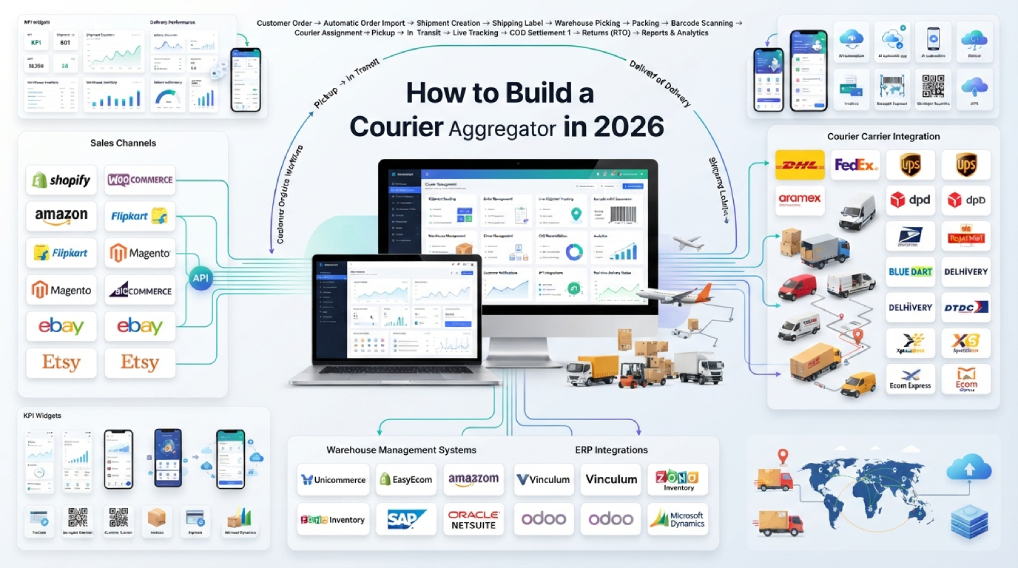
A courier aggregator is essentially a multi-carrier shipping hub: a web or mobile platform that lets shippers access dozens of couriers via a single interface. For businesses (especially D2C shipping software users), this means no separate contracts or logins. Instead, one system fetches quotes and tracking from FedEx, DHL, Blue Dart, Xpressbees, and others simultaneously.
Why build one? Modern brands report big gains with multi-carrier solutions. For example, companies using multi-carrier shipping software “often save up to 20% on shipping costs”. Handling all carriers in one place also cuts manual work: one blog estimates consolidating couriers can reduce operational effort by 30–40%. Real-time rate-shopping avoids overpaying on fuel surcharges or excess fees (common in India). It also enables flexible routing – choosing the fastest or cheapest courier per order – which improves reliability and speeds up delivery.
In short, the aggregator removes bottlenecks: one dashboard shows every active shipment and every courier’s performance. A satisfied customer sees a tracking link, not a frustrating delay. With global pressures (customers demand 2–4 day delivery everywhere) and high COD returns, this centralized shipping approach is no longer a luxury – it’s a necessity for scale.
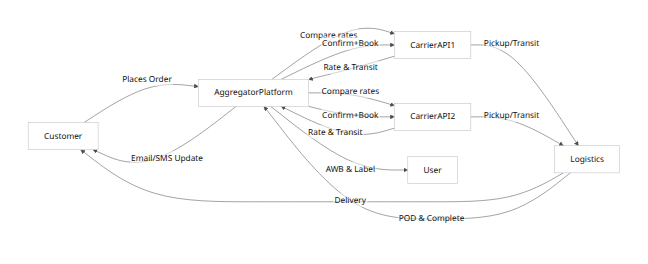
Figure: [MERMAID] A simplified order flow in a courier aggregator system.
Step 1: Choose Your Niche and Business Model
Before coding, define who you serve and how you’ll earn. A courier aggregator can focus on local couriers, intercity parcels, e-commerce shipping, B2B freight, or international imports. It could target D2C e-commerce brands needing 2-day delivery, or urban same-day retailers, or a specific vertical like cold chain. Picking a niche sharpens pricing and marketing: for example, an intra-city delivery aggregator might charge flat fees or surge pricing, whereas a large-volume B2B service might use negotiated bulk rates.
Most aggregators earn by commission or fees. Common models include:
- Per-shipment commission: Take 5–15% of each booking (couriers pay for the leads).
- Service charges: Add a small convenience fee to each order.
- Subscriptions: Charge businesses (often monthly) for premium dashboards or volume discounts.
- Value-adds: Revenue from package insurance, packaging sales, or fast-track fees. For instance, many platforms include “GST-ready billing” and invoice automation as premium features for enterprise clients. Think through cash flow – if COD is prevalent (as in India), you must handle remitting that cash. Aggregators often aggregate COD from multiple couriers into one payout (daily or weekly), improving working capital.
Example: If your aggregator starts with 1,000 shipments/month averaging ₹2000 each, and you charge a 5% commission, that’s ₹100,000 revenue. Factoring in return rates and tech costs, profitability usually improves as volume grows. Check if your region needs licenses or complies with logistics regulations (insurance, GST, etc.). A solid business plan here ensures that as order volume hits e.g. 50–100/day, your model scales without breaking a sweat.
Step 2: Develop the Technology Platform
With a clear plan, build your aggregator software. Key features include:
- User registration & dashboard: Businesses log in to book shipments and track orders.
- Pickup & delivery entry: Simple forms for addresses, package details (weight/dimensions), and service type.
- Rate comparison engine: Real-time quotes from all partner couriers. The software should pull rates via APIs and display cheapest vs fastest options.
- Multi-courier selection: Let users auto-assign based on rules (e.g. cheapest for COD, fastest for prepaid) or pick manually.
- Booking & label printing: Upon confirmation, the system should generate airway bills (AWBs) and printable labels via each courier’s API.
- Order management: A consolidated view of all orders, statuses, and events, regardless of carrier.
- Real-time tracking: Aggregate tracking updates from carriers so customers can check progress in one place.
- Notifications: Send SMS/email updates at key milestones (pickup, in-transit, delivered).
Crucially, focus on user experience. Our experience shows that a confusing workflow kills adoption. Keep booking steps minimal and mobile-friendly. Use clear, trustworthy wording (“Instant Rate Comparison”, “Trusted Delivery Partners”, etc.). Build dashboards for three audiences: end customers, couriers, and admins.
Tech Architecture (high-level): The core is a server (cloud-based) that connects to each courier’s API for rates and bookings. A database holds customer profiles, orders, and tracking data. A web/mobile frontend handles the UI. Consider microservices or modular design: e.g. a “rate engine” service, a “tracking aggregator” service, etc. (A novice team might start with an off-the-shelf multi-carrier TMS and customize it, but we focus on custom build here.) Security is key: protect data, integrate secure payment gateways (prepaid/COD verification), and comply with local data laws.
Mermaid Architecture Diagram:
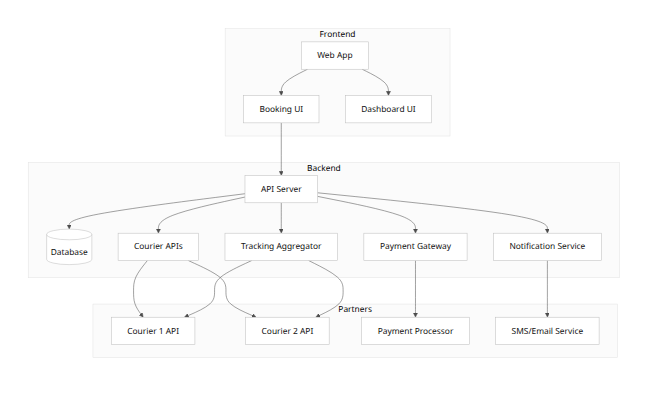
(This simplified diagram shows user-facing booking and dashboard UIs talking to a backend that interacts with courier APIs, payments, notifications, and stores data in a database.)
Step 3: Integrate Couriers and Automate
With the platform in hand, onboard courier partners. Start with major carriers that fit your niche. For each partner, set up:
- API integration: Connect to their systems for rate quotes and booking. (Most couriers now provide REST APIs.)
- Pricing agreements: Ensure your system applies the agreed rates and margins.
- Service definitions: Clearly define each service (e.g. “Next Day Express”, “Standard 3-5 Days”) and any zone/weight limits.
- Operational details: Establish pickup schedules, documentation needs, and NDR (Non-Delivery Report) processes.
Automation will be your differentiator. For example, implement auto-routing: the system can automatically assign the best courier by rules (cost, speed, or even machine learning models). Shipmozo cites “AI-Based Courier Allocation” to select optimal routes. While AI is advanced, a simple rule engine can do the job initially. Also set up automated notifications: once a booking is confirmed, the courier’s AWB is sent to the customer via email/SMS, the dispatch team is alerted for pickup, and tracking links are updated automatically.
Handle returns and RTOs with care. Offer pre-printed return labels (many B2C brands do this), and integrate a quick RTO re-booking within the system. Since RTOs kill margins (up to 30–40% of orders in India), minimize them via checks: at the least, validate pin codes and mobile numbers during booking.
Finally, ensure accounting flows smoothly: use the platform to generate consolidated invoices for clients and to reconcile COD remittances. An automated GST-ready billing system for India (a checklist item) will save headaches.
Step 4: Focus on Operations and User Experience
A smooth operation sets successful aggregators apart. Here’s what to nail:
- Simple Booking Flow: From login to “Shipment Booked” should be no more than 4–5 steps. Show clear progress indicators.
- Transparent Pricing: Display the all-in price (including fuel surcharges, COD fees, etc.) before confirmation, so users trust the quote.
- Dashboard and Tracking: After booking, both sender and receiver should see live status updates. A branded tracking page (with your logo) builds trust.
- Communication: According to industry reports, 60% of failed deliveries stem from poor coordination. Counter this with proactive alerts. For example, allow recipients to specify delivery windows or confirm via WhatsApp two hours before arrival (as iCarry suggests).
- Quality Checks: Embed address validation (auto-complete via Google Maps or postal APIs) and mobile OTP verification. Data shows ~45% of Indian RTOs are due to bad addresses. Prevent these on the frontend.
- Customer Support: Provide easy contact (chat, email, phone) for queries. Since you handle packages, being responsive is critical to “build trust”.
Remember, the goal is to make shipping feel painless. One aggregator story noted that simply reducing manual steps by 30–40% returned customer trust (people buy again if deliveries are consistently on time).
Step 5: Launch, Marketing, and Growth
With a working platform and partners in place, go to market:
- SEO & Content: Optimize your site for terms like “courier aggregator”, “multi-courier shipping” and niche keywords. Publish helpful content (shipping guides, courier comparisons, city pages) to attract businesses searching for shipping solutions.
- Paid Ads: Run Google Ads targeting “e-commerce shipping”, “bulk courier services” etc. A small e-com seller googling “fast shipping in Bangalore” might become a customer.
- Partnerships: Tie up with e-commerce platforms and marketplaces. For instance, integrate your system with Shopify or WooCommerce so store owners can plugin easily.
- Outbound Sales: Reach out to potential clients (SMBs, manufacturers). Demonstrate ROI: e.g., “We saved [Company X] 25% on shipping costs in 3 months”.
- Early Users Incentives: Offer discounts or free trials to initial customers to build case studies. In onboarding, one startup launched in 6 months and handled 2,000 shipments/day by offering promotional rates – illustrating the scaling potential.
Metrics to track: Monthly shipments, average cost per shipment, RTO rate, customer satisfaction. Aim for hitting a critical volume: as FlatWorld notes, once you exceed ~50–100 shipments/day, multi-carrier automation pays off. For example, at 10,000 shipments/month (~333/day) with an average shipment cost of $5, even a 20% saving is $6,000/month.
Here is a sample development timeline (Mermaid Gantt):
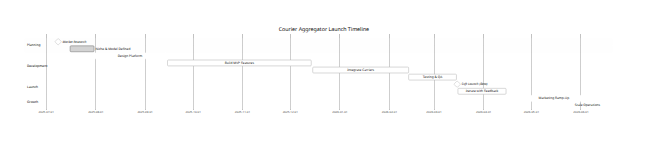
(This is a hypothetical schedule; adjust for team size. It shows ~3–4 months to MVP before going live.)
Challenges and Pitfalls
Any aggregator startup must expect hurdles. Here are some critical ones and how to mitigate them:
-
Delivery Delays & Churn: Slow or failed deliveries upset customers fast. Research shows delayed deliveries can increase churn by ~40%. Combat this with robust partner SLAs and tracking alerts. Build a “delivery boost” team or use last-mile tracking – iCarry suggests two-way WhatsApp updates to solve miscoordination. In practice, handing a failed order to a backup courier immediately can salvage many shipments.
-
Partner Coordination: If couriers blame each other for missed pickups or payments, operations stall. Agree on clear SOPs up front. Use contracts that define pickup times, penalties for non-service, and timely POD submission. Maintain a layer of communication: for example, an admin panel tracking every pickup request and completion, so manual follow-ups can be minimized.
-
Pricing Competition: Aggregators often undercut each other. Don’t engage in a pure price war. Instead, differentiate through service (e.g., faster insurance claims, better support). If you are aggregating courier shipping software itself, license or white-labeling costs can erode margins; consider revenue share models where possible.
-
Technology Maintenance: As volume grows, your platform must scale. Common mistake: launching with a brittle MVP. Plan for scaling databases and servers. Also, have a process for quick bug fixes and updates – downtime erodes trust faster than anything.
-
Regulatory Issues: In some regions, cross-border shipping or even domestic parcels require licenses/insurance. Don’t overlook GST compliance or data privacy (e.g. personal address info). Factor legal counsel early in planning.
-
Customer Acquisition: Many aggregator businesses fail by focusing only on tech, neglecting marketing. Keep budgets for ads and sales staff. Track your CPA (cost per acquiring a shipper). In many cases, the business turns viable only after reaching a certain client count or shipment volume.
Example: From Idea to Launch
Imagine SpeedyShip Ltd., a hypothetical startup. By January 2025 they had a prototype connecting 3 courier APIs. In 6 months they onboarded 50 small retailers, handling 500 shipments/day at ₹150/shipment on average. Through multi-carrier selection, they cut shipping cost by ~20%, which translated to ~₹45,000/month savings for their clients. They offered live chat support and managed to reduce their clients’ RTO from 25% to 15% in that period by validating addresses and pre-confirming COD orders.
Their key to growth: listening to customer pain points. When several clients reported frequent delays in Tier-3 areas, SpeedyShip added a new local courier partner specializing in that region. This improved their delivery success by ~10%. By the end of the first year, they had 120 active business users and plans to expand internationally.
This case illustrates that building a courier aggregator is iterative: start small, prove the concept, then expand services. Use the data you gather (delivery times, cost savings) as testimonials to attract the next 100 users.
Key Takeaway
Building your own courier aggregator in 2026 means solving real pain points: fragmented shipping, high costs, and tedious logistics for businesses. With the right niche focus, robust software, and reliable partners, you can turn these challenges into an advantage. The ultimate goal is to make shipping simple and transparent for users. If your platform can make one small business say, “Wow, shipping used to be a headache but now it’s a breeze,” you’ll have built something truly valuable.
The future of commerce is fast delivery and happy customers – and a well-built courier aggregator will be at the heart of it.
Figure: Aggregators unify multiple courier networks into one platform (source: iCarry).