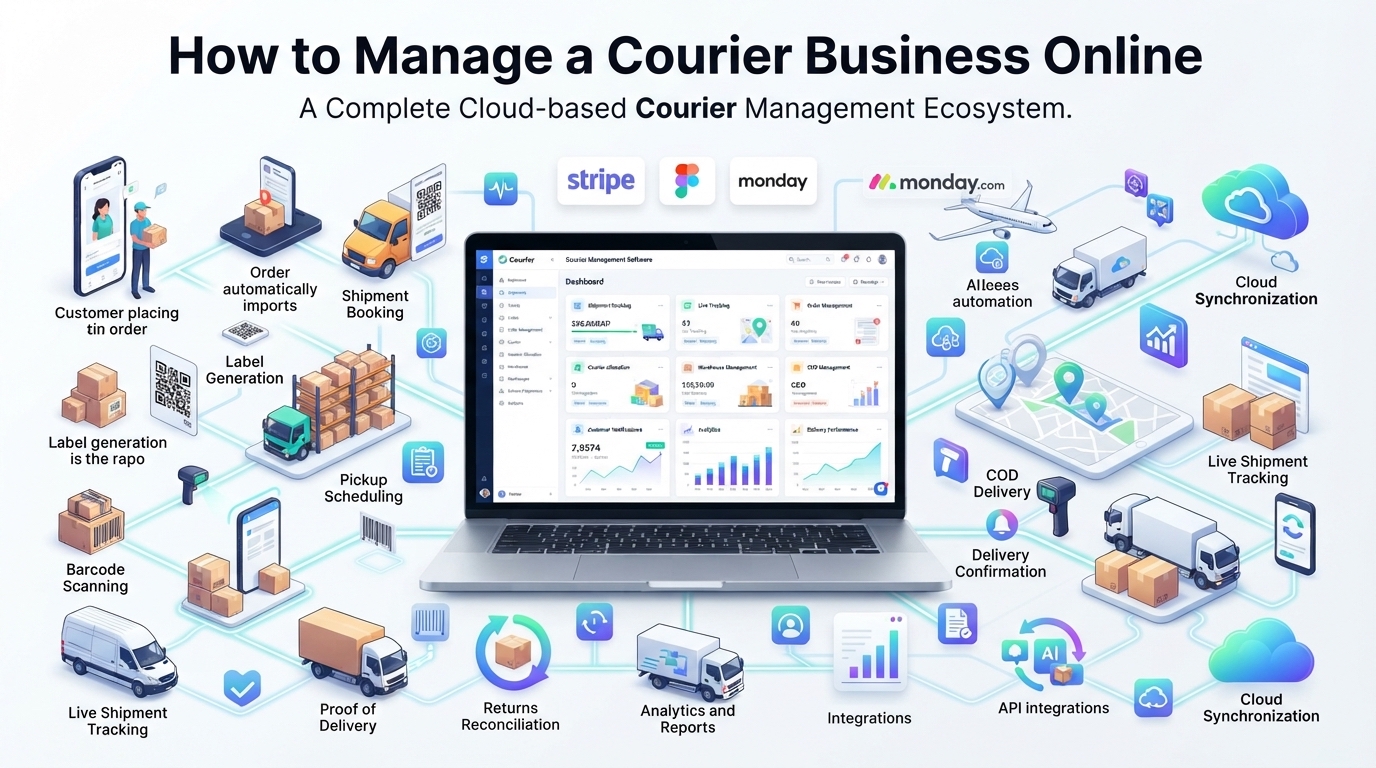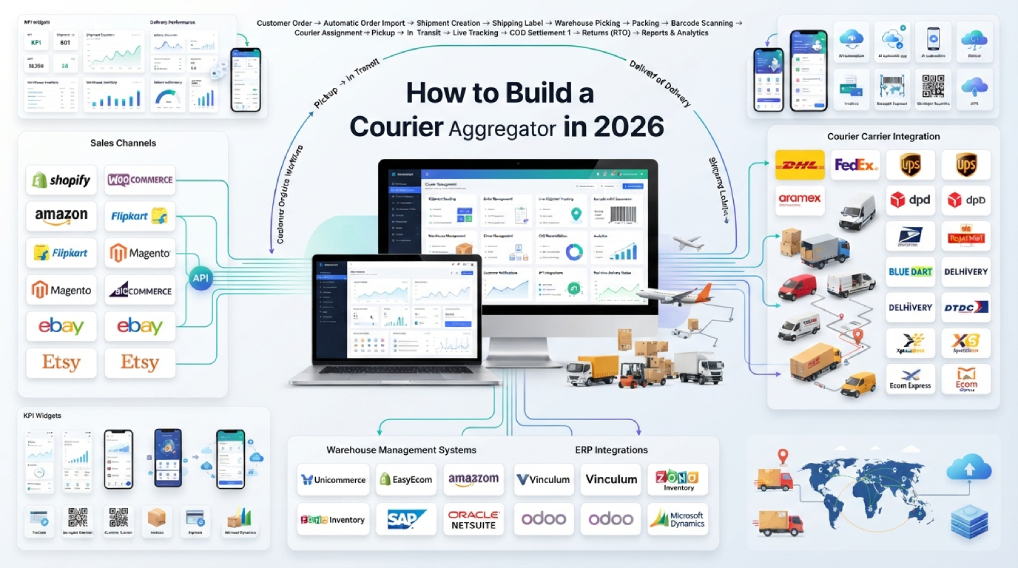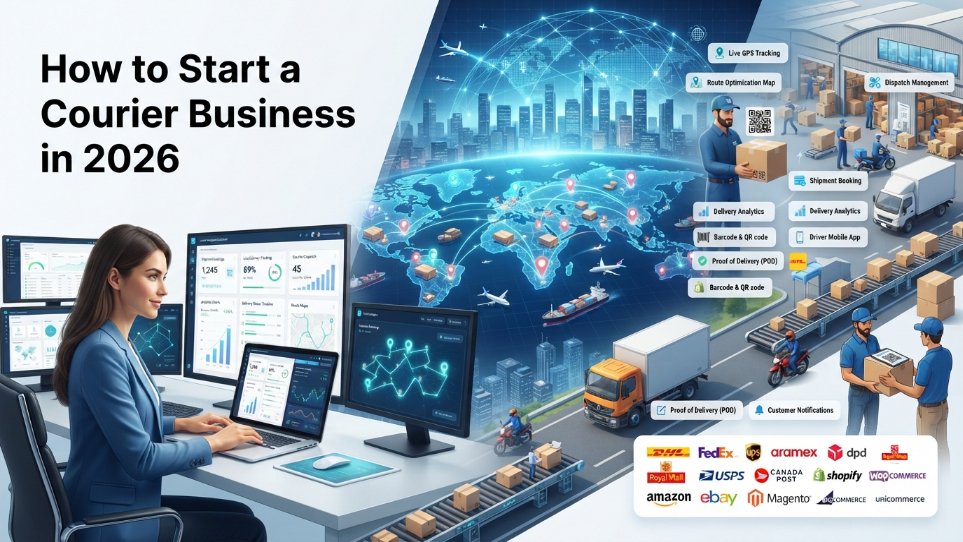
If you’re delivering packages with a notebook and a map, you’re not alone – but you won’t stay efficient for long. By 2025 the US courier and local delivery market topped nearly $180 billion, and global parcel volumes are surging toward half a trillion dollars. In this boom, even one-van operators can carve out a niche – if they plan ahead. In this guide we’ll show how to start a courier business in 2026 with real-world detail, from choosing your niche and vehicle to evaluating dispatch and delivery route optimization software. We’ll draw on our years of building courier software, so you’ll read about the tech tools that make or break a small delivery business (for example, drivers using route optimization often cut fuel costs 15–30%). You’ll also hear common objections (“I’m too small for fancy software!”) and why those fears aren’t fatal. By the end you’ll have an actionable road map for going from spreadsheets to scalable efficiency – with clear takeaways, not fluff.
Choose a Niche and Model
The first mistake many new couriers make is trying to deliver everything. Pick a focus from day one. Specializing narrows competition and even lets you charge more. Common niches include medical courier (labs, prescriptions, specimens), legal courier (court filings and documents), same-day local delivery (retail or e‑commerce partners), B2B bulk parcels (scheduled runs between businesses), or fragile/temperature-controlled goods. Each niche demands different vehicles and insurance – for example, medical work often means small vans with refrigeration and drivers cleared for HIPAA compliance; same-day couriers might use bikes or small vans in cities to beat traffic.
Decide early whether you’ll be a one-van owner‑operator or a small fleet owner. Most founders start on their own and drive the van themselves – it keeps costs down and lets you learn the trade. When you add drivers, your “software stack” changes: you’ll need true dispatch software instead of just a nav app. Be honest about your plan. (If you think “someday I’ll run three vans”, design your systems for multiple vehicles from the start. Otherwise you’ll rebuild later.)
For example, John ran legal couriers around Manchester. He started with his own hatchback, but as soon as he got steady bank runs, he needed a van to fit the paperwork. If your planned niche needs heavy gear (furniture) or strict compliance (blood samples), factor that in now. Steer clear of “deliver anything” thinking – the wrong van or cover can kill your margin.
Set Up Legally and Financially
Before the first delivery, get the paperwork right. In the US that means registering as an LLC, S-Corp, or sole proprietor (talk to an accountant about liability). In the UK you’ll register as a sole trader or limited company and notify HMRC. Pick the structure that suits your risk comfort. Then register your business with the proper authorities and get any required local permits or licenses. For most couriers this means a basic business license from the city or county; if you cross state lines in the US you may need interstate authority (USDOT numbers) or customs clearance. In short: get a quick consultation from a local business adviser or accountant and tick the boxes now, because operating without them can shut you down fast.
Next, arrange insurance. Courier insurance differs from normal vehicle cover – you’ll need goods-in-transit insurance on top of your auto policy. This protects the packages you carry. For any specialty cargo (hazardous materials, large equipment, medical specimens), you’ll need extra cover and possibly training (e.g. Hazmat or HIPAA for patient info). Don’t skimp: losing one claim or shipment can sink a small startup.
Write a lean business plan. It doesn’t have to be a 50-page tome – more a checklist with numbers. Define your customer (retailers? labs? law firms?), list your fixed costs (van payments, insurance, software subscriptions) and variable costs (fuel, maintenance, packaging). Calculate your break-even – e.g. “I need $X in revenue per week to cover $Y costs.” Having a clear $/mile or $/stop number tells you if a job is worth taking. Those ambitious growth charts are nice, but cover your near-term runway first – most courier startups fail for cash-flow reasons, not lack of demand.
Calculate Costs and Pricing
Be realistic about what you need to spend. Startup costs often include: your vehicle (buy or lease), insurance and licenses, a smartphone or scanner, basic packaging supplies, and maybe some marketing (flyers, a website). A used van can run $10–30K, plus insurance ($1–5K/year). You should budget a few thousand for software tools too – as one blog suggests, set aside on the order of $1,000–$5,000 for everything from route planning to dispatch software.
Ongoing costs are fixed vs variable. Fixed: insurance renewal, vehicle tax/MOT, accounting/bookkeeping (or software), and any subscription fees for platforms or software. Variable: fuel (which is unpredictable), maintenance and repairs, tolls or congestion fees, packaging materials, and cell data for apps. Remember to factor in your own pay and taxes. A good rule is to “price for profit” from day one. There’s no point beating competitors on price if you undercut yourself into a loss. In practice many local couriers charge in the ballpark of $45–65 per hour in the US (or £150–300 per day in the UK) depending on distance and urgency. Charging per mile, per stop, or flat-rate + surcharges for after-hours are all valid models – just make sure your pricing covers all your costs with a margin on top. (As one experienced courier once said: cheap early contracts aren’t a foundation, they’re a trap.)
Get the Right Vehicle and Equipment
Your van is your office. A small city van or even car might do for documents or small parcels. For standard courier work, a medium panel van is common. Think ahead: if you plan to grow, consider maintenance, fuel economy, and any emissions regulations (like London’s Ultra-Low Emission Zone). Make sure the van’s cargo space (payload) matches your niche (lab samples need refrigeration, furniture needs open space and a tail lift, etc.). If money is tight, a reliable used van is better than a shiny new one that strains your budget.
Aside from the vehicle, kit yourself out. Essential gear includes secure straps and padding for loads, a strong hand-truck or dolly, and a phone with good navigation. Many couriers start with a basic smartphone and perhaps a simple GPS app. But plan to upgrade: you’ll likely want a dedicated device (or a tablet in the van) for a driver app. Paper manifests and Excel sheets? They’re fine for Day 1, but you’ll see the benefits of better tools soon.
Evaluate Delivery Route Optimization and Tracking Software
This is the point that separates a fleeting sideline from a lasting business. A one-man courier with ten stops in a city can manually plot routes each morning – but as you grow, inefficiency kills your bottom line. Fortunately, modern delivery route optimization software can pay for itself quickly. For example, courier owners who switch on route optimization often see 15–30% less fuel use and more efficient runs. In practice this means doing more deliveries per shift and squeezing out costs.
Key features to look for:
-
Route Planning / Optimization: Converts your list of addresses into the fastest or shortest route that meets time windows. The software should respect constraints: vehicle size, delivery time commitments, and traffic. A system that recalculates in real time (say, to avoid roadworks) is ideal. As one specialist write-up notes, inefficient routing is “one of the biggest hidden costs” in logistics.
-
Dispatch / Driver Assignment: Often called courier dispatch software or courier management software, this feature lets you assign jobs to drivers automatically based on location and availability. Instead of calling drivers or manually updating spreadsheets, the system pushes a schedule to each driver’s app. Look for drag-and-drop capability and clear driver status.
-
Real-Time Tracking and Customer Notifications: Today’s customers expect to know where their deliveries are. Good courier tracking software shows GPS location of each driver and can send automated SMS/email updates at pickup, in-transit, and on delivery. This branded “Where’s my order?” experience cuts down on customer calls. Onfleet highlights this: having live tracking links and auto notifications means fewer “where is my package” headaches.
-
Proof of Delivery (ePOD): Check that the driver app can capture a signature, photo, or barcode scan for each drop. Digital proof of delivery closes disputes and is often required by clients (especially pharmacies or legal firms). Ideally it syncs back to your central system so you have records without manual input.
-
Order Import and Reporting: This sounds fancy, but it’s just convenient. Being able to upload orders from a spreadsheet or integrate with a merchant POS saves you typing addresses every morning. And analytics (stop counts, miles, costs) help you see where money goes.
-
Ease of Use and Support: You and your drivers must actually use the tools. Pick solutions with good mobile apps (high app-store ratings are a plus) and responsive support. Onfleet’s guide emphasizes driver adoption: “Drivers hate buggy apps” – the right platform should have a clean interface so nobody reverts to phone calls or paper.
-
Integration/API: Even as a small operator, consider future integrations. Modern platforms offer APIs or built-in hooks to e-commerce stores or accounting software. For example, if you ever expand into e-commerce deliveries, you might want your system to talk to Shopify, WooCommerce or Zapier. It’s not mandatory day one, but platforms with open API docs make life easier down the road.
How to evaluate? Start small: pick a provider that offers a free trial or low-cost entry tier. For instance, some courier dispatch apps have generous free plans (one review notes one popular platform’s free tier covers 300 orders per month). During the trial, feed in a few typical runs and see how well it optimizes them. Do you save time or miles compared to Google Maps? Check the driver app: is it stable and intuitive? Did customers appreciate the tracking link? Remember [VERIFY] everyone’s workflows vary; the guide advises trying real routes and real constraints when evaluating software. Even better, start with a pilot: choose one day or one area to test the new system instead of flipping on a full fleet all at once.
Addressing Common Objections
Small couriers often balk at software because of cost or complexity. But the cost of not using software is higher. Consider these real concerns:
-
“Software is too expensive.” The market now has options for every budget. Some route-planning apps are free for a single driver and give advanced optimization. Basic courier dispatch systems start around $30–50 per month per driver. Given that route optimization can cut 15–30% of fuel and time costs, and that tracking software avoids service failures, the ROI often comes in weeks. Also note you can start on a minimal plan. One review highlights free tiers: e.g. Shipday offers a very generous free plan (300 monthly orders) covering optimization, GPS tracking and proof-of-delivery. You can get into it for essentially zero to start.
-
“I’m not tech-savvy.” Modern courier platforms are built for non-tech businesses. They usually have clean, app-based interfaces. If your drivers know how to use Uber or WhatsApp, they can learn these apps. To minimize learning curves, choose a solution with high ratings and good documentation. The best approach is to onboard slowly: maybe start by using the route planner on your own phone for a week, then ask your driver to try the app for one route. The staged approach (“pilot with new business”) avoids disruption.
-
“What if it fails on me?” Many fear switching will break current service. In practice, running parallel systems for a short period can ease the transition. Keep using your old manifest method while you test the new system. Once the new tool proves reliable (driver does one route with it), switch entirely. Successful migrations suggest doing it region by region or route by route. Also, modern APIs mean most tools export data, so you won’t lose historic records. Just export old orders into the new system’s format, and ask for help from their support if needed. You’ll avoid missing hours of cashflow by doing that properly.
Delivery Route Optimization Software
A sub-genre here is route optimization software. This is the core feature of the stack. A standalone route optimizer can instantly improve efficiency. For a one- or two-vehicle shop, even a smartphone app (like Bodha Drive, Route4Me, or others) can plot multi-stop routes. For fleets, you’ll want a full solution with multi-driver dispatch, so that when a new job arrives, it automatically finds the best driver and time slot.
For small couriers, ensure whatever route-planner you pick allows manual tweaks. In practice, no algorithm is perfect: you might know a shortcut or client-specific nuance. Good software lets you drag stops or swap drivers if needed. Over time, that investment in optimizing routes will pay off in fewer empty miles – the Bodha route blog reports that margin is often “fuel” and planning.
Set Pricing and Find Your First Contracts
When your van is ready and your books are set, it’s time to get work. Many small couriers start by calling nearby businesses. Drop off a flyer at local law firms, pharmacies, print shops and offices. Ask what they pay now and what annoys them about their carrier. If you niche down (say “we’re the friendly same-day medical courier”), people will remember you more easily. Even a simple introductory email with a spreadsheet of rates can land contracts.
Also sign up on courier platforms. In the UK there’s Courier Exchange (free to list and get work). In the US consider apps like GoShare or Roadie (although those often pay lower rates). Being active on platforms can fill gaps while you build direct clients. The key is reliability: one on-time delivery with proof-of-delivery record can turn a trial gig into a regular contract.
Build credibility early: show up on time with the right equipment, and follow up every delivery with an invoice and a thank-you. Word of mouth is gold in this business. If you impress a client, they’ll often ask when you can do it again. Long-term contracts come from that trust, not from marketing gimmicks. Remember, a “bad delivery” often means you’ve lost a client forever. So focus on fulfilling what you promise, and the rest (money, referrals) follows.
Scale and Continuously Improve
Once you have steady work, reinvest in efficiency. If you started solo, ask when it makes sense to add a second vehicle or driver. A red flag is when your daily planning and invoicing start overflowing your spreadsheet. When you hire a driver, move quickly to a multi-driver dispatch system. Many entry platforms let you add a second user for a modest increase.
Keep an eye on your key metrics (you should by now have the cost per stop, average stops per day, fuel usage). Route and dispatch software often has analytics built in – use it. For example, if you notice two stops are always late, maybe your transit time estimate is off or a traffic pattern changed; update your planning accordingly.
Also, don’t grow too fast on credit. Fund your runway. Most small courier failures happen because invoices land after 30–60 days, but bills (loans, insurance) do not. If you need financing to buy a van or cover early payroll, consider a small loan or line of credit. Some local couriers have succeeded on nothing but a personal credit card for the first few months, but keep track of the interest cost. As Bodha’s checklist reminds: fund several months of operating runway, not just the setup costs.
Conclusion: Hit the Road Smarter
Starting a courier business in 2026 isn’t about “reinventing the wheel” – literally or figuratively. It’s about applying best practices to a classic service. Here are the takeaways to keep you ahead:
- Niche wisely. Don’t be all things to all people. Your chosen niche shapes everything from your van and insurance to your pitch.
- Be planful, not panic-driven. Clear assumptions about costs and pricing save you from burning out or running out of money. Work out your break-even delivery count and stay on top of invoices.
- Invest in tech early. Even for a solo van, free or cheap route-planning and tracking apps will pay off almost immediately by saving fuel and reducing errors. And when you add a driver, a courier dispatch app becomes indispensable. Pick software with the core features we discussed: route optimization, live tracking, ePOD, and integrations. (You can demo first – remember to start with real routes to see real savings.)
- Service sells. Fast, on-time deliveries with confirmed POD and friendly communication create loyal customers. Nothing beats consistently making the customer look good.
- Scale with care. As you grow, keep an eye on cash flow and efficiency. Add drivers and vehicles only when you can fill them profitably. Revisit your routes and routes, and refine.
The local delivery boom isn’t slowing yet. But it’s the disciplined, tech-savvy courier owners who will last. By blending solid old-fashioned service with modern courier dispatch and delivery route optimization software, your startup stands a real chance of thriving in 2026. Get your niche, van, and paperwork right – then let smart routing and tracking do the heavy lifting.
Ready to turn the key on your courier startup? Start with the niche you know and a plan in hand. Test your first routes on an app tonight – you might be surprised how much fuel a smarter route saves you tomorrow.
Sources: Industry statistics and guidance were drawn from courier and logistics resources (Courier Exchange, Shopify/IBISWorld).